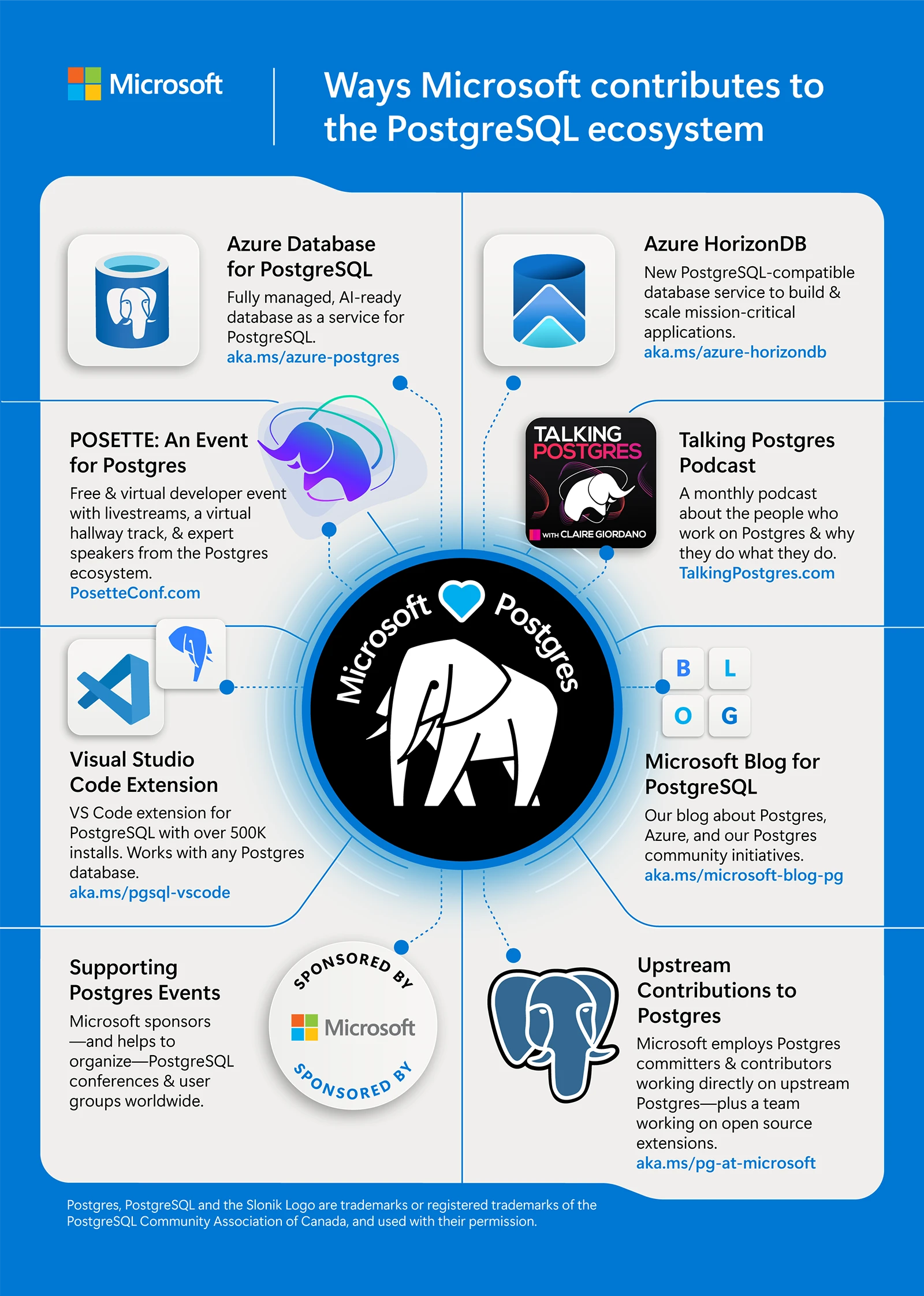
PostgreSQL has become foundational to how modern applications are built. It powers everything from early‑stage startups to some of the most demanding production systems in the world. Its longevity isn’t accidental, it’s the result of decades of engineering discipline, community collaboration, and a relentless focus on correctness and extensibility. As application architectures evolve, and as AI becomes a default part of the software stack, PostgreSQL continues to adapt . This adaptability is a key reason Microsoft has been investing deeply in PostgreSQL: 345 commits contributed to the latest PostgreSQL release, a team of PostgreSQL committers and contributors working directly on the upstream project, and a growing portfolio of managed services, developer tools, and community programs built around Postgres on Azure . Here’s what’s driving that investment, and what it means for the people building on Postgres today. Figure 1: This infographic highlights the many ways Microsoft contributes to and supports the PostgreSQL ecosystem Discover Azure HorizonDB Why PostgreSQL, and why now Across industries, PostgreSQL is increasingly the default choice for new workloads and modernization projects. That shift is driven by three clear trends. PostgreSQL is trusted with real production systems PostgreSQL earned its reputation by solving hard problems in production environments: transactional correctness, concurrency control, extensibility, and operational resilience. These characteristics weren’t designed for isolated benchmarks; they emerged through years of running mission critical systems under real pressure. Microsoft runs PostgreSQL at global scale and sees these same patterns firsthand. Many upstream contributions, such as recent work in PostgreSQL 18 on asynchronous I/O, vacuum behavior, and query planning, are informed directly by production bottlenecks encountered at scale. This feedback loop works both ways. Improvements made upstream benefit the entire PostgreSQL ecosystem, while lessons learned from large‑scale deployments continue to inform future development. Databases are becoming part of the AI stack Databases are no longer isolated storage layers. In modern systems, they increasingly sit inside feedback loops that involve reasoning, ranking, and decision‑making. Developers building AI‑enabled applications are asking new questions: How close can vector data live to transactional data? How can similarity search respect SQL predicates? How can inference, ranking, and structured data work together without excessive glue code? PostgreSQL’s extensibility makes it a natural foundation for these patterns. That’s why Azure Database for PostgreSQL and Azure HorizonDB focus on integrating AI‑related capabilities , such as vector search and model invocation, directly into familiar PostgreSQL workflows. Different workloads, different paths to scale As applications scale, not every workload benefits from the same architectural approach. Some teams want a fully open, single‑node PostgreSQL experience with minimal abstraction. Others need elastic scale, multi‑zone replication, and fast failover but don’t want to push complexity into the application layer. This diversity is why Microsoft supports multiple PostgreSQL deployment models on Azure: Azure Database for PostgreSQL for open‑source‑aligned workloads and lift‑and‑shift scenarios. Azure HorizonDB for cloud‑native systems that require scale‑out compute, shared storage, and low‑latency global resilience. These aren’t forks. They are different engineering responses to different workload realities. Get started with Azure Database for PostgreSQL Upstream collaboration and developer tooling Microsoft’s investment in PostgreSQL goes beyond product announcements for Azure’s managed services to include shipped code from in-house contributors, upstream collaboration, and production reliability. As our learnings expand, we’ve used these insights to enrich the open-source Postgres engine for the broader community. Upstream contributions that benefit everyone Postgres committers and developers at Microsoft actively contribute to the PostgreSQL open source project, working alongside the global community on core improvements. Recent version updates include contributions across: Asynchronous I/O foundations. Performance improvements in vacuum and memory management. Planner and execution enhancements for large datasets. These changes land upstream first, ensuring that improvements are broadly available not tied to any single cloud or service. A transparent overview of our Postgres work is published annually . Architectural motivations behind Azure HorizonDB Azure HorizonDB was built to address a specific class of PostgreSQL workloads that are constrained by single node scaling but not well served by application level sharding. For example, high-throughput, low-latency systems that require horizontal scale without adding application complexity. Key architectural goals shaped Azure HorizonDB: Independent scaling of compute and storage. Failover and recovery operations decoupled from data size. Multi‑zone replication enabled by default. The result is a PostgreSQL‑compatible service with a shared‑storage, scale‑out design supporting sub‑millisecond multi‑zone commits and growth to thousands of cores , without requiring application rewrites. Azure HorizonDB extends PostgreSQL’s reach while maintaining compatibility expectations that developers rely on. Improving the developer experience where work actually happens PostgreSQL has long been a developer‑centric database. Tooling investments on Azure reflect that mindset. With more than 500,000 installs, the Visual Studio Code extension for PostgreSQL brings provisioning, schema exploration, performance diagnostics, and migration workflows directly into the IDE developers already use . Integrated GitHub Copilot assistance helps with SQL authoring, tuning, and even complex migrations, such as Oracle to PostgreSQL, which i
Originally published at azure.microsoft.com